Amy Potthast | Instructional Coach & Designer | Learning Design Studios

Archive for the ‘Reflection on Instructional Practice’ Category

Spaced learning and one-off workshops

How to encourage learners to spread out their learning, when you have one shot to teach them.

According to John Medina’s Brain Rules, you’ll learn best through re-exposing yourself to new information at specific intervals.

This kind of learning is called “spaced learning” and is in contrast to cramming, or a study method I call “How I Passed my Freshman Computer Programming Course at CMU”—memorize a lot of code, then type it in the right place on the exam, then go home for winter break and never think about it again, ever.

So, if spaced learning is the ideal, how do you encourage it, when you’ve only got a one-hour workshop or presentation (instead of, say, a semester-long college course)? The following are some ways that I have tried — I’d love to hear what you’ve tried! Leave a comment below.

Close your workshop with a review

If you don’t already, review the workshop content as part of your wrap up. There are lots of ways to do this, depending on how much time you’ve spent together. An easy way is to look back at the objectives for the workshop and quiz participants on how well they’ve met them. Learners will remember the end of the workshop better than the rest of it, so reviewing the content at the end sends them home with the key points fresh in their minds.

Ask learners to explain new ideas to a friend

The best way to learn is to teach. Task your learners with explaining a new concept, teaching a new skill, or discussing a new issue with a friend. Reviewing content orally is a kind of elaborative rehearsal — repeating the content in a relatively complex way that anchors it in long-term memory better.

Give a homework assignment

Clearly optional, homework assignments invite learners to take their interest in your subject one step further. Ask learners to read a specific book from the library, reflect on the topic in writing, interview an expert to learn more, watch a film, create something new.

The homework assignment will allow your learners one more exposure to the new skill or content area, helping them review and revisit what they learned from you during the workshop.

Encourage learners to take & review their notes

Leave space in your handouts for learners to take notes. Encourage them to review their notes during the week following the workshop.

—-

How do you encourage your learners to deepen their knowledge of workshop content?

Fonts and dandelions – exploring the looks of things

My final course in grad school Creating Training Documents is a crash course in graphic design. We’ll be crafting smart-looking facilitator’s and participants’ guides for various projects — mine will be for the EPIP program I’m developing.

In preparing a design brief for my project, I have spent the last hour browsing free fonts & downloading them to inDesign. You can see some of the fonts I found to the left.

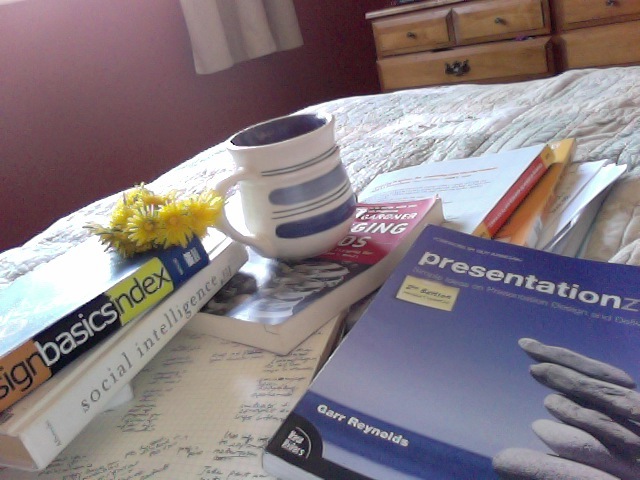
Also I’ve been following links to sites like I Love Typography, reading about a Canadian blogger Todd Macfie’s trip to TypeCamp India. And Smashing Magazine out of Freiburg, and reading PresentationZen, Design Basics Buttercups, coffee cup, design booksIndex, and Logo Savvy. I’ve been looking under the hood of websites to see what fonts they’re posting in.

As I’m plugging away on coursework today, I glanced at the bed to see a little bunch of dandelions my four year old picked for me this morning — sweet thing for him to do, bringing a little sunshine inside on this great spring day. But I’m also loving the aesthetic of it. Saturated with imagery, to see a still life here in my room.

Public identities, authentic reputations, professional brands

In a couple weeks Russ Finkelstein* and I will head down to San Francisco and LA to pilot our first workshop in the training program we are creating for EPIP (Emerging Practitioners in Philanthropy).

Our affinity process highlighted the potential of so many workshops we could develop, but the first four we’re prioritizing include personal/professional branding, networking, leadership self-assessment, and facilitation.

In addition to creating the lesson plan and handouts, we’ll create pre-assessments, post-workshop evaluations, facilitator materials, and a webinar for each topic.

In California, we’ll pilot the personal/professional branding workshop. In preparation, I’m reading Reid Hoffman’s new book The Start Up of You. In it he articulates something I’ve been trying to find language for — about keeping your identity separate from your employer. It’s such an important point at a time when people shift jobs every couple years.

Inevitably people ask about whether their Twitter feed is their own or their organization’s voice. I think that is hard to answer, and I know that you can lose your job or face other real-life consequences for something you say on your own Twitter feed because that’s happened to people — journalists, politicians, etc.

The point is that you can write about your world outside of work; use your blog or LinkedIn profile or Twitter feed to discuss your independent projects, reading, networking, etc. Representing yourself as a professional is, I guess, an unspoken expectation.

I’m excited about the chance to work with young foundation professionals on these issues and to learn from them how these concepts play out in their own careers.

* Russ is my old boss from Idealist, and my collaborator on the EPIP project now.

Evaluation and meta-evaluation

Program evaluation. So many options and moving parts. So many potential approaches that evaluation looks kaleidoscopic.

We recently undertook meta-evaluations, at the planning level, within my grad school cohort. I loved reading about the diverse projects my colleagues are designing, and thinking about how we’ve devised diverse evaluations in response.

There’s no one-size fits all eval because the programs themselves are complex and varied. Evaluations reflect the programs (“evaluands”), the questions that stakeholders are asking, the skill and knowledge of the evaluator, resources like money and time.

Reading through several eval plans helped me realize how essential evaluation skills are for building the capacity of individuals and organizations.

Although I’m not aware of a professional association for nonprofit program directors, I imagine if there were one, evaluation skills would be an central skill set to help directors develop, alongside the better-attended-to worlds of budgeting, fundraising, communications, people and project management, etc.

Participatory eval models like Fetterman’s Empowerment Evaluation seem perfect for such a purpose, equipping program directors with the feedback they need to make sharp planning and management decisions on an ongoing basis.

Facilitating affinity groups at a distance

To design a professional development training program for Emerging Practitioners in Philanthropy, I wanted to follow the outcomes-based instructional design practice of convening subject matter experts as a starting point.

In-person affinity groups

Ideally, the designer brings together subject matter experts who represent diverse perspectives on the training topic. The experts brainstorm, share, and group answers to the question, “What do participants need to be able to do, out in the real world, as a result of the training program?”

Each expert writes their responses on sticky notes, introduces each note to the group, and post it to a wall. After the experts have all spoken, they come together to compare and group their responses.

Throughout, the designer challenges the experts to focus on action statements — and to avoid verbs such as “to understand” and “to know.”

From each cluster, the designer and experts wordsmith a first draft of an outcome statement, something like: “As a grant maker, evaluate the financial workings of current and prospective grantees.”

Affinity groups at a distance

Because the EPIP subject matter experts lived across the country from each other, I had to sort out a different way to run the affinity process.

George Reese, of Gateway to College National Network, and my instructional design professor at Oregon State, consulted with me about the process (even though our term together had ended). He recommended connecting with SMEs one-on-one or in small groups over the phone, rather than try to convene them as a group.

So this is what I tried. Each chat was about an hour long. I took notes on Google docs and shared them  with each expert afterwards, asking them to correct or clarify.

Once the experts had confirmed the notes, Russ and I grouped them, and I drafted outcomes — referring to the rubric from class as a job aid. I also looked at survey results from EPIP members, where they reflected on what kind of professional development they wanted.

Then I met with Russ Finkelstein, my partner on this project, to look through the outcomes and make sure they adequately reflected the notes. Russ is a coach at EPIP and my former boss at Idealist.

Once we finalized the outcome statements, we brainstormed a list of workshops that might be appropriate in the training program.

Next steps

Right now, EPIP staff and chapter leaders are looking at our long list of workshop topics to decide on 6-8 they’d like us to create. We’ll work on the first four of this this spring — an onland and online version of each.


Protected: Victory! An article: “What Constructivism Demands of the Learner”

This content is password-protected. To view it, please enter the password below.

Drafting sections one and two of the constructivist paper

Tonight I drafted Section One of the Constructivist Paper. That it is a draft is a wee bit confusing to me, because I am not clear how complete it needs to appear. Do I need to include all my references to date formatted in APA? Wouldn’t I rather keep researching rather than pause a moment to write up my findings to date? (Yes!)

I feel that I can say more about what I did not learn and how I will not be using my findings, than how I will use the learning. I did not learn whether I enjoy constructivism as an instructor; I didn’t facilitate students through a learning contract.

Also, to answer the question about what I had learned from each resource, I used a table to organize the information. On the one hand, that is a graphic organizer in and of itself, though it goes on for too many pages! But also, do I need more of a narrative introduction to the table? And currently the table is organized chronologically by when I encountered the resource, rather than by alphabetical order of the source.


Taiwan mathematics reform, using a constructivist instructional design approach

In Annual proceeedings of selected research and development [and] practice papers Presented at the National Convention of the Association for Educational Communications and Technology. Vol. 1-2. p. 259-264

This morning I read a paper from 2001 examining the implementation of a mandatory elementary school mathematics reform in Taiwan that took place in 1996-ish. Apparently, it’s come under a lot of criticism, but not related to student outcomes (at least that is not addressed in this paper). The criticism comes more from issues related to how the reform was implemented — not enough stakeholder buy-in, even from among the teachers expected to change their teaching methods.

Some useful information here relates to conducive environments:

1) Instructors must buy-in to implementing constructivist courses and programs. In the Taiwan example, teachers weren’t part of the impetus for reform; apparently many teachers opted to retire early rather than change their methods and others kept teaching using objectivist approaches. I don’t know what the impact on student outcomes the lack of buy-in has had, but surely the students of these teachers did not succeed within constructivism which is my research question.

2) Schools should apply constructivist ISD approaches widely, not related to a single academic subject area. In the Taiwan example, the author argues that educational leaders did not view the mathematics reform as related to the need for systemic transformation, but was part of a piecemeal “attempt to improve fragmented and outdated educational reforms.”

One source the author cites is Chung (1997) — Chung reviewed student outcomes after the constructivist reform — but his/her study comes from an in-service training for Taiwanese teachers, and is in Chinese. Although I read Chinese (better at simplified Chinese that’s common on the Mainland), I don’t know that I’d be able to locate the article though I would love to see what Chung found.

The final useful thing I learned about was the “Major Guidelines for the Redesign Process” developed by Reigeluth, Norris and Ryan which the author applies (in retrospect) to review the Taiwan reform. If I can find it, it might be useful to learn what are good practices in general, not related specifically to constructivism. It was published in a report from the Indiana University School of Education so may not be easily available.

Wu, Y.S. (2001). Systems design: An analysis of the implementation process of Taiwan’s constructivist approach elementary mathematics curriculum. In Annual proceeedings of selected research and development [and] practice papers (1-2), (259-264).

Critical thinking and constructivism

Reading: Allen, M. (2008). Promoting critical thinking skills in online information literacy instructions using a constructivist approach. College and Undergraduate Libraries, 15 (1-2) 21-38.

So from the abstract I could extrapolate that the author presumes that more constructivism champions a more active learning style than students are accustomed to from “traditional” approaches.

Conducive environment…
On page 31, Allen argues that, “in order to provide a true constructivist-based learning environment, instructors and instructional designers must plan carefully from the beginning of the instruction to the end.”

On. p. 33 she continues, “creating true constructivist-based instructional materials and online learning environments can be difficult, time-consuming, and not warranted in every situation” (see below for more detail)…

p. 33, quoting Bostock (1998): “A radically constructivist course would be more difficult to implement within the constraints of large numbers, resources, and institutional culture, so it is cheering to think that a partial implementation of constructivist principles may actually be optimal for the majority of students.”

Students who succeed…
Allen compares solving complex, “ill-structured” problems as one of the core principles of constructivist learning. “This type of problem, conceived of by the instructor or designer, may be a case study, scenario, or ultimate desired goal statement that provides the learner with important component information, but offers no direction and no obvious solutions to the stated problem. The use of the ill-structured problem is typically used in instructional settings where the learner already possesses a great deal of prior knowledge. The the learner must use his or her previous skills and apply them to the proposed situation to formulate a plausible solution” (pp. 31-32) — italics are mine.

On p. 33 she continues, “In environments where students are so inexperienced that they have very little prior knowledge to build upon, a constructivist-based approach would likely overwhelm them.”

The latter quotations reinforce my sense that students who succeed within constructivism have prior experience with the subject matter or processes required to answer their research questions.

She writes, “some learners simply do not thrive in a constructivist environment. As Bostock observes, ‘Some students will enjoy the challenges of constructivist learning while others will sometimes find them uncomfortable and need more objectivist instruction.”

I will look up Bostock; I wish Allen were more specific about why some students enjoy constructivism and others do not thrive.

Strategies:
On p. 33, Allen says, “It may, in such cases [where students are inexperienced], be more advisable to provide a more straightforward, objectivist approach….”

on p. 33, quoting Cooperstein and Kocevar-Weidinger: “Designing suitable activities requires careful planning and greatly increases preparation time. Finding perfect examples and problems that will lead students to an appropriate ‘Aha!’ experience is difficult requires a great deal of intense, time-consuming work,” (145).

I searched for the Cooperstein & Kocevar-Weidinger paper through the a couple databases on the OSU library site and couldn’t find it but will look again.

Questions for cohort survey

Thanks for Twodolla from Flickr Creative Commons

Thanks to Twodolla from Flickr Creative Commons

In attempting to answer my questions for the constructivist  assignment, I’m going to survey my classmates about their experiences with the assignment.

  • How would you rate the constructivist assignment (check all that apply)
    • Loved it/had fun with it
    • Tough getting started but I found my stride
    • Struggled with the assignment consistently
    • Did not see the point of it
  • For you, how would you compare your experience in the constructivist assignment, compared to the objectivist assignments we’re more used to? The constructivist assignment was….
    • Easier
    • More fun
    • More interesting/engaging
    • Resulted in more learning
    • Same
    • Harder
    • Less fun
    • Less interesting/engaging
    • Resulted in less learning
  • What challenged you about the constructivist assignment?
  • Were you able to write the learning contract before starting work on the contract?
    • Yes
    • No
    • Not sure
  • What helped you or would have helped you?
  • For you and your development, what were pros of the constructivist assignment?
  • What were the cons?
  • Are you satisfied with the results so far of the project? Did you learn what you set out to learn?
  • In many ways our internships are also constructivist assignments. How would you rate your internship(s)? Check all that apply.
    • Loved it/had fun with it/them
    • Interesting experience
    • Tough getting started (the work, or finding an internship) but I found my stride
    • Struggled with the internship consistently
  • What has challenged you regarding your internship(s)?
  • What has helped you make decisions regarding your internships, or would have helped?
  • How long have you been working in the field of adult education?
  • What’s your GPA so far?
    • 3.5-4.0 (A+)
    • 3.0-3.4 (A)
    • 2.5-2.9 (B+)
    • 2.0-2.4 (B)
    • 1.5-1.9 (C+)
    • 1.0-1.4 (C)
    • Less than 1.0